

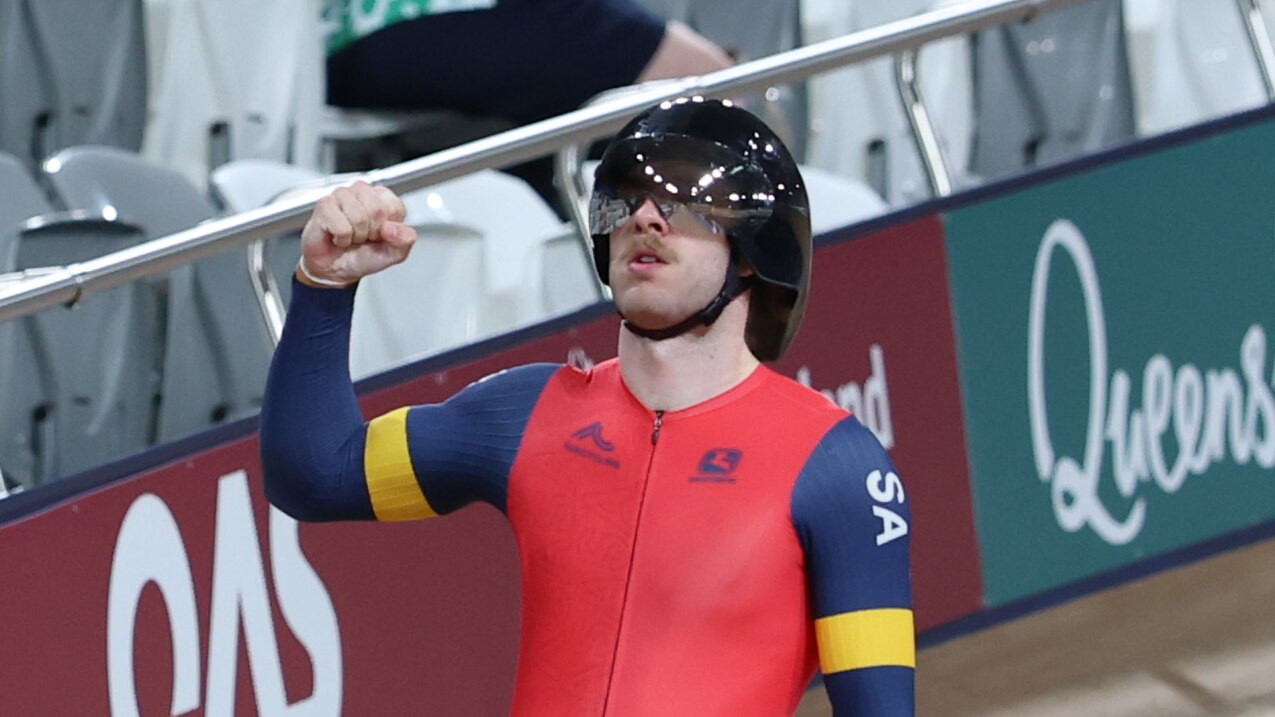
Hoffman and McCaig Dominate National Cycling Championships with Stunning Doubles
Leigh Hoffman’s triumphant roar echoed around the velodrome as he crossed the finish line, a dominant display of power and determination securing him his maiden national keirin title. Gritting his teeth, Hoffman had launched an audacious move to the outside of a three-wide bottleneck of rivals, surging clear to claim a hard-fought victory. This win marked a significant milestone in his career, cementing his status as the undisputed king of Australian sprint cycling by completing the coveted double of the keirin and individual sprint titles at the national championships for the first time.
The celebrations were not confined to the men’s field. Alessia McCaig also showcased her exceptional form, mirroring Hoffman’s achievement by clinching both the individual sprint and the keirin on Saturday. This remarkable feat marked her third consecutive year achieving the double, extending an impressive four-year streak of dominance in the keirin event.
“I’m stoked, four in a row is crazy,” McCaig exclaimed after a thrilling blanket finish in the six-lap, derny-led keirin race. “I decided to give it a bit of a crack [as it was] the last race of the week and leave it all out there. I broke a PB and didn’t lose a race all week, so I’d say that is a 10 out of 10 week for me.”
Hoffman Steps into the Spotlight
At 25 years old, Hoffman, the reigning world championship silver medallist, acknowledged he still has ground to cover to match McCaig’s sustained success. Nevertheless, he has truly come into his own as the leading figure in Australia’s sprinting ranks, particularly following the retirement of Matt Glaetzer and the defection of Matt Richardson to Britain.
The Whyalla-born rider had primarily excelled in the team sprint event prior to and at the Paris Olympic Games, serving as a blistering fast lead-out man for the two Matts. With Richardson now representing Great Britain, Hoffman has seized the opportunity to step up significantly. His individual medal haul at the world championships last year in Santiago, including a silver in the keirin and a bronze in the individual sprint, has ignited his ambition.
Earlier in the week, Hoffman secured his second national sprint title, setting a new Australian record for the fastest flying 200m on home soil with a blistering 9.321 seconds. He quipped that it was “good to rub Richo’s [Richardson’s] record out.” Armed with that victory and the national champion’s jersey, Hoffman reaffirmed his prowess in the chaotic and often unpredictable world of elite keirin racing, proving too powerful for his domestic rivals.
“It’s been a good week,” Hoffman shared. “I’ve still got a bit of a wrist injury that’s still persisting a bit, so we’re trying to give it as much rest as possible, so no team sprint for me [on Sunday]. It will be the same at the Hong Kong World Cup in two weeks. That’ll be the last international before Commonwealth Games, so same there, sprinting keirin again for me, big focus on the individual, and then hopefully by Commonwealth Games the wrist should be fully healed and can rip into the team sprint.”
The Allure of the Keirin
While elite sprinters often place greater value on the individual sprint – a tactical head-to-head duel famously contested by Australian Anna Meares against British rival Victoria Pendleton – the keirin holds a special appeal for fans.
“For myself, it’s individual sprint [that’s the key race],” Hoffman stated when asked about the most significant race for sprinters. “It’s the fastest man on the track, give or take. There’s less external factors that go into it. Keirin racing, anyone can win it. It’s a horse race on bikes, basically, you know?”
The inherent chaos and unpredictability of the keirin were instrumental in its inclusion in the Olympic Games for the first time at the Sydney 2000 Games, attracting the attention of UCI officials.
‘A Different Type of Racing’
Japan has long been regarded as the spiritual home of the keirin, with the sport first emerging in 1948 in Kokura as a fundraising initiative for post-war reconstruction. As one of only four sports where betting is officially sanctioned in Japan, keirin racing can be highly lucrative for its participants, albeit in a format that differs significantly from the international circuit.
“It’s different racing,” Hoffman explained. “Steel bikes, outdoors, 333-metre tracks, where this is 250 metres. So, yeah, totally different type of racing.”
Despite these differences, the Japan Keirin Autorace Foundation (JKA) has periodically invited elite UCI racers to compete on the otherwise closed professional circuit. Former Australian track star Shane Perkins has been a vocal advocate for racing in Japan, having competed there for over a decade to help fund his UCI career. Matt Glaetzer also cited his nine-month stint racing Japanese keirin in Izu as a career highlight.
For the first time since the COVID-19 pandemic, the JKA has opened its doors to international competitors once more. This season’s invited riders include four-time keirin world champion and reigning Olympic champion Harrie Lavreysen, along with Matthew Richardson, whom he narrowly beat for gold in Paris. British rider Joe Truman will also be competing. New Zealand’s Ellesse Andrews and Dutch rider Hetty van de Wouw, who secured gold and silver respectively at the Paris Olympics in the keirin, have also been invited, as has French two-time European champion Mathilde Gros. The first races are scheduled for June, with the invited riders already in Japan undergoing training on the distinctive steel-framed bikes.
This influx of international talent is a strategic move aimed at revitalising the sport’s declining popularity and addressing the negative connotations associated with its strong ties to gambling and an aging fan base. While Hoffman and McCaig were not among the invited riders this year, Hoffman expressed his keen interest in participating in the future.
“I was definitely keen on it,” he said. “After worlds this year, I was hoping I’d get a call-up, but I think they’ve only selected three [male riders]. I’d definitely be open to it. It’s a pretty big experience and a bit of money in it as well, which is definitely a plus.”
The Perils of the Keirin
The Japanese version of the keirin is known for its intense physicality, with riders often likened to “boxing on wheels” by Shane Perkins, as described in Justin McCurry’s book “War on Wheels.” Riders are even equipped with body armour due to the combative nature of professional racing.
While the elite keirin races at the national championships concluded without incident, Saturday night at the track saw a spate of crashes across various events. Several riders in the under-17 scratch races sustained injuries, overwhelming the small medical area at the Anna Meares Velodrome, with a queue of injured riders waiting for treatment.
In the elite scratch races, a gruelling and tactical affair saw Queensland’s Noah Blannin stake a strong claim for a Commonwealth Games spot with a superb victory. Meanwhile, South Australia dominated the women’s race, securing a podium sweep with a tactical masterclass. New Zealand rider Rylee McMullen claimed the win, ahead of her teammates Maeve Plouffe and Sophie Edwards.