
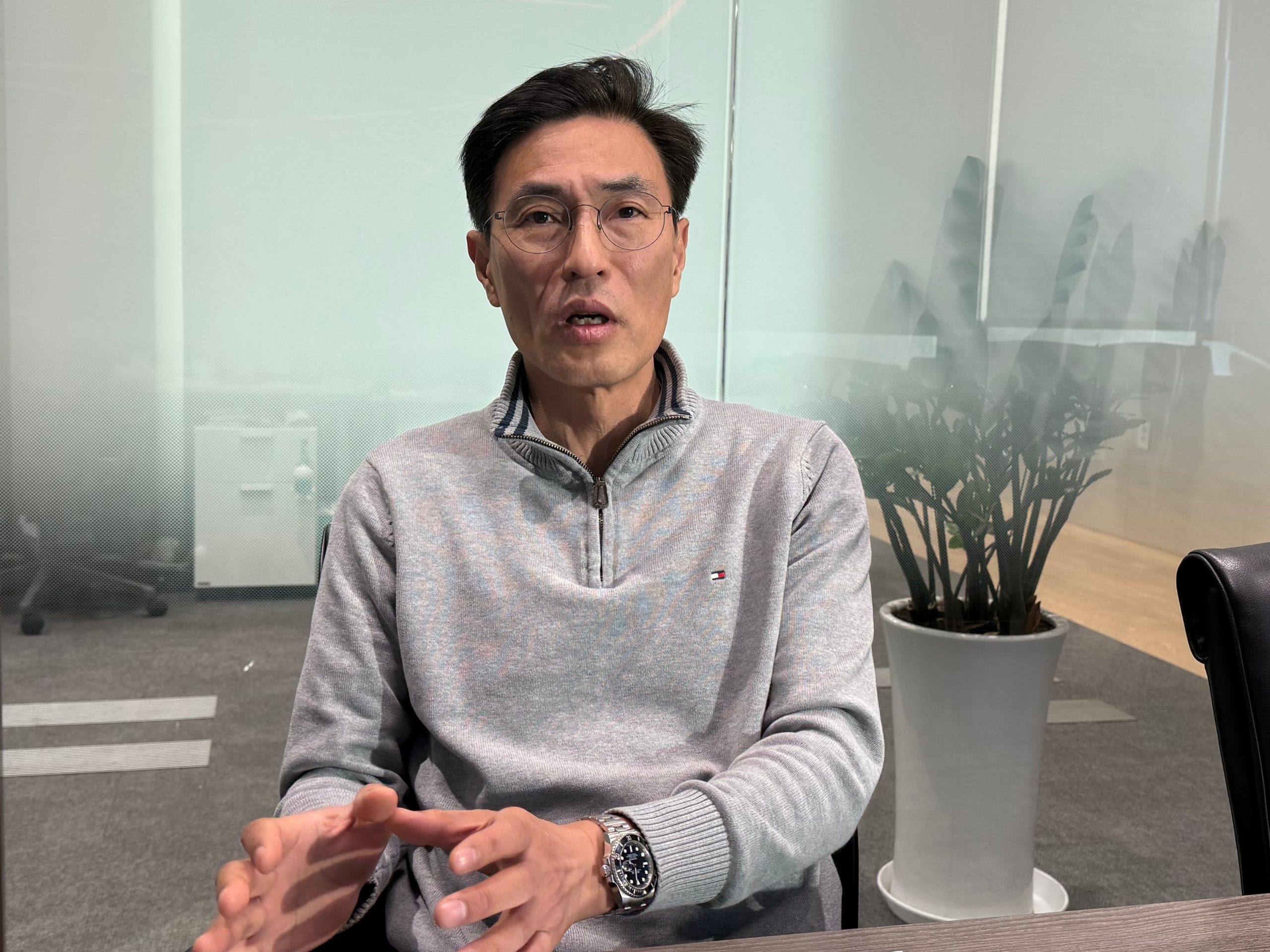
“The government hopes export companies will sell some of the dollars they earn on the market to ease high exchange rate pressures, but companies on the ground are protesting, ‘We have no dollars to sell.’ They argue that with massive investments in the U.S. required starting next year, they are not in a position to sell dollars.”
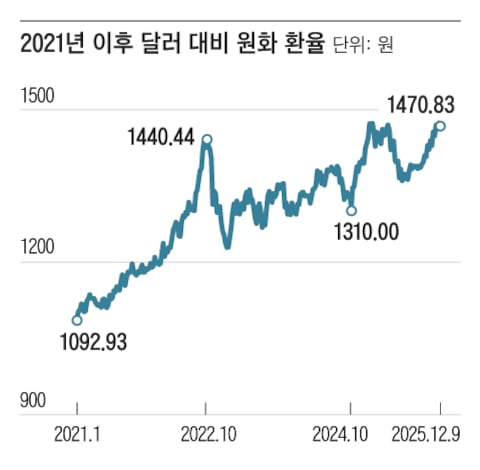
Despite government efforts, the exchange rate remains stubbornly above 1,400 Korean won per dollar, fueling concerns that this level could become the “new normal” in the coming year. Factors such as the anticipated change in leadership at the U.S. Federal Reserve and the full implementation of U.S. investments tied to tariff negotiations are expected to continue influencing the exchange rate. One currency analyst predicts it will be difficult to push the exchange rate lower until at least the first half of next year. This is largely attributed to the continued growth of Korean individual investors’ U.S. investments and the significant annual U.S. investment commitment, potentially reaching $20 billion, which will likely maintain a high exchange rate.
The Lingering 1,400 Won Exchange Rate: A Possible “New Normal”?
Why the Sharp Increase This Year?
The impact of individual overseas investors has been substantial. A shift towards a tighter monetary policy by the Federal Reserve in August led to a temporary dip in the exchange rate as individual investors sold overseas stocks. While other factors might have contributed, the political climate stabilized after the presidential election, and measures to promote capital market advancement encouraged investment in the Korean stock market. However, October witnessed a record outflow of stock investment funds, followed by a net outflow of approximately $4 billion in November. Simultaneously, foreign investors sold approximately 14 trillion Korean won worth of stocks on the KOSPI, further contributing to the exchange rate’s rise.
The Connection Between Korean Investment in the U.S. and Foreign Stock Sales
A correlation exists between these two trends. Concerns about the overvaluation of AI (artificial intelligence) companies, particularly in the U.S., triggered intensive selling of semiconductor-related stocks in Korea by foreign investors. This risk aversion, coupled with AI overvaluation worries, led to a sell-off of Korean stocks. Korean investors reportedly absorbed a significant portion of these shares, potentially supporting stock prices but having a negligible impact on the exchange rate since these were won-denominated transactions. Conversely, Korean investors perceived the decline in U.S. tech stocks as a buying opportunity. They reasoned that even if the dollar’s value declined, potential gains from stock price appreciation could offset any losses.
The Risk of Losses Upon Future Sales
The risk of losses does increase if the exchange rate weakens at the time of future sales. Some argue that an improving Korean economy and a stronger current account surplus, driven by more proactive responses to U.S. tariffs, could lead to a decrease in the exchange rate. Others believe the high exchange rate may become entrenched as a long-term trend. Some predictions even suggest the exchange rate could reach 1,500 won per dollar next year.
Factors Potentially Driving the Exchange Rate Higher
The U.S.-China trade conflict is a critical variable. Despite hopes for a smooth resolution to tariff negotiations, it appears unlikely. China continues to pursue its interests while offering limited concessions on U.S. demands. A prolonged period of negotiation, marked by reciprocal actions, is more probable than a swift resolution. This uncertainty increases risk aversion in the foreign exchange market, potentially driving the won exchange rate even higher.
The Reality of a “New Normal” at 1,400 Won
A longer-term perspective is necessary to assess this. In 2022, the exchange rate remained above 1,400 won for approximately four months. After late last year, it fluctuated around the 1,400 won level for about five months due to political uncertainties and U.S. tariff concerns. After a brief dip to around 1,350 won, it has remained above 1,400 won since September. The won-dollar exchange rate has repeatedly crossed the 1,400 won threshold. From a quantitative analysis perspective, it does seem plausible that this is becoming the new normal. The fact that the exchange rate has not fallen below 1,400 won despite a continued current account surplus suggests that the 1,400 won exchange rate is becoming entrenched, at least for now.
The Impact of U.S. Rate Cuts
Limited Effect of Rate Cuts on Exchange Rate
It’s difficult for foreign exchange authorities to intervene effectively when individual investors are driving the exchange rate. Government intervention is more effective when speculative forces are distorting the market for short-term gains. However, when individual overseas investors are the primary driver, intervention may struggle to stabilize the exchange rate. The government is attempting to use the National Pension Service to stabilize the exchange rate and encourage companies to sell dollars earned through trade, but this is proving to be a complex challenge.
Why Companies Aren’t Selling Dollars
The majority of companies earning dollars through exports are large conglomerates in sectors like semiconductors, shipbuilding, and automobiles. The government is primarily negotiating with these companies to sell dollars. However, these companies need to significantly increase investments in the U.S. to comply with tariff regulations. This includes direct investments and building factories in the U.S., requiring them to hold onto their dollar reserves.
The Role of Government Foreign Asset Returns

The government plans to secure up to $20 billion annually for U.S. investments, consulting with companies on how to do this. But what happens if the government can’t secure the full $20 billion? Could companies be forced to provide the funds? While not a certainty, companies cannot ignore this possibility. If the exchange rate rises further, companies might face a situation where they have to buy dollars at a higher price after selling them now.
The Impact of a New Fed Chair
The U.S. Federal Reserve Chair is expected to be replaced, with Kevin Hassett, a White House National Economic Council director, being a possible candidate. If a Fed Chair aligned with current policies lowers the benchmark rate, traditionally the dollar’s value should decrease. However, Korea’s current situation is more intricate. Risk assets include both the won and U.S. stocks, meaning Korean investors may prefer buying U.S. stocks, offsetting the downward pressure on the exchange rate. Also, the pre-arranged U.S. investments will affect the exchange rate.
Minimizing the Impact of U.S. Investments
The government has stated it will try to minimize the foreign exchange market impact from U.S. investments. The plan involves initially covering the annual $20 billion in U.S. investments with foreign exchange earnings and, if necessary, issuing foreign currency bonds. However, if the U.S. benchmark rate is cut by 1 percentage point or more, the returns on Korea’s foreign assets, such as U.S. Treasuries, will also decrease. This could necessitate increased foreign currency bond issuance to cover the $20 billion, potentially destabilizing the won exchange rate. In the worst-case scenario, if foreign currency bonds cannot be issued on time, the government might have to buy dollars from the market, further weakening the won. While aggressive U.S. rate cuts could somewhat stabilize the exchange rate, it’s unlikely to return to the 1,200-1,300 won per dollar range solely due to this.
The Real Concern: Inflation
The Impact of Fed Rate Decisions
The market anticipates a rate cut at the upcoming Federal Reserve meeting. However, the market’s expectation of rate cuts is the critical issue. U.S. indicators suggest a cooling job market with decreasing layoffs and hiring, while tariff hikes create inflation risks. These conflicting factors make the Fed’s decision particularly challenging. If the Fed freezes rates despite the market’s expectation of cuts, the exchange rate could rise sharply again.
Breaking Common Assumptions
Many traditional assumptions about exchange rates are proving unreliable. The theoretical “mean reversion model,” which suggests that exchange rates tend to revert to a long-term average, is weakening. The pattern where Korean companies earning dollars would strengthen the won, making exports sluggish and causing the exchange rate to fall again, is less predictable now.
Reasons for the Shift
The emergence and policies have disrupted the global trade order. These interventions have transformed the overall economic and financial environment. Increased geopolitical instability, marked by major wars, a new Cold War between the U.S. and China, and potential scenarios like a Chinese invasion of Taiwan, contribute to the instability. These global variables have challenged the assumptions that have been in place since the post-Cold War era, making it difficult to predict market movements based on established theories.
The Risk of Crisis

Past foreign exchange and global financial crises have led to improved preparedness. Low ratios of short-term external debt to GDP and manageable “CDS premiums” (indicators of sovereign bond default risk) have prevented the high exchange rate from spreading to other areas. However, inflation remains a concern. While prices haven’t risen sharply yet, a further increase in the exchange rate could push inflation above the mid-2% range, making it harder for the Bank of Korea to cut rates. A high exchange rate and rising inflation could shrink consumption capacity, risking economic damage. A high exchange rate directly increases import raw material prices, posing a heavy burden on small and medium-sized enterprises.
The Forecast
While predicting the second half of next year is premature, the exchange rate is expected to remain upward, hovering above 1,400 won, at least until mid-next year.