


AI Tools Transforming Personal Finance in the UK
A significant number of adults in the UK are turning to artificial intelligence (AI) tools to manage their personal finances. According to recent research, over half of adults—approximately 28.8 million people—have used AI tools to help manage their money within the past 12 months. This marks a notable shift in how individuals approach financial management.
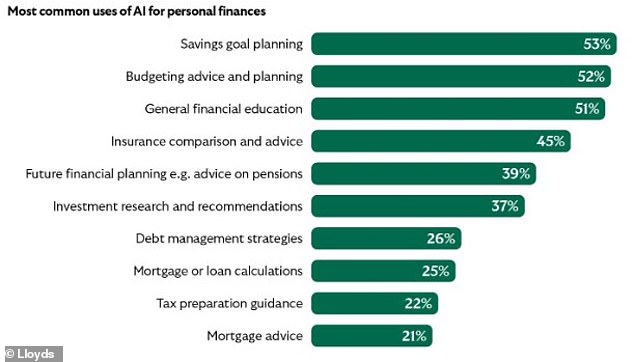
Personal finance has now become the primary use of AI in the UK, with many people relying on chatbots for assistance with budgeting, saving, and financial education. The most common application of AI in this context is helping users plan their savings goals, with 53% of people using the technology for this purpose. Similarly, 52% use AI to plan their budgets, and 51% utilize it for financial education.
Beyond these everyday tasks, AI is also being used for more complex financial activities such as future financial planning, investment research, debt management, and tax preparation. A survey by Checkout.com revealed that two out of five households would allow AI to spend their money if it meant they could save time on routine tasks like paying bills.

Lloyds Bank highlights that 87% of people are now confident using the internet, a rise of four million individuals over the past five years. The number of people using mobile banking apps has tripled to 21 million. Jas Singh, chief executive of consumer relationships at Lloyds, emphasized the transformative impact of AI on personal finance: “AI is rapidly transforming how people manage their money, with the potential for millions of consumers to feel more confident and in control of their personal finances.”
He added, “From everyday budgeting to planning for the future, we’re already seeing people use the technology to make smarter choices and build financial resilience.”
However, despite the benefits, there are challenges associated with AI adoption. The main barrier identified by Lloyds is a lack of trust, with 83% of people concerned about data privacy and 80% worried about receiving outdated information. Additionally, 70% of users express concerns about the lack of personalization in AI-driven financial advice.
Singh noted, “As AI becomes a bigger part of our financial lives, trust is the next frontier. People want to be sure the information they receive is accurate, secure and truly tailored to their needs.”
He continued, “That’s why banks have a vital role—not just in providing cutting-edge technology, but in combining it with trusted expertise and a deep understanding of our customers. Our focus is on building tools people can genuinely rely on—helping everyone to benefit from the confidence and clarity that digital solutions bring.”
Real-Life Experiences with AI in Personal Finance
For 34-year-old Nicola, a data analyst from Brighton, AI has become an essential tool in managing her finances. She shared, “Apps are a way of life for me. I use them all day, every day to manage everything from planning our home renovation to managing my banking.”
Nicola credits AI, particularly ChatGPT, for helping her find a reward credit card that suits her needs. “It was so quick. If I’d tried to do that research myself, it would’ve taken ages,” she said. She also appreciates how AI simplifies other aspects of her life, including finding competitively priced flights, planning holidays, and accessing fitness plans and recipes.
“ChatGPT is now my first port of call,” she added. “Friends and colleagues were talking about it, and I was a bit sceptical at first. I thought: ‘Is it safe? What data are they storing?’ But once I started using it, I realized—this is amazing. You can literally type anything into it.”
Nicola highlighted the value of AI in budgeting and tracking spending. “It’s useful to see: ‘These are your bills, this is what you spent on petrol, this is what you spent on clothes last month.’ When you’ve got loads of transactions, it can be difficult to keep track, but these tools can make sense of it.”
She also mentioned using AI when remortgaging to determine the best time to look for a new deal and to understand complex financial terminology. “Finances can be a bit overwhelming, but I feel like it’s educating me.”