

Labour Market Challenges Continue
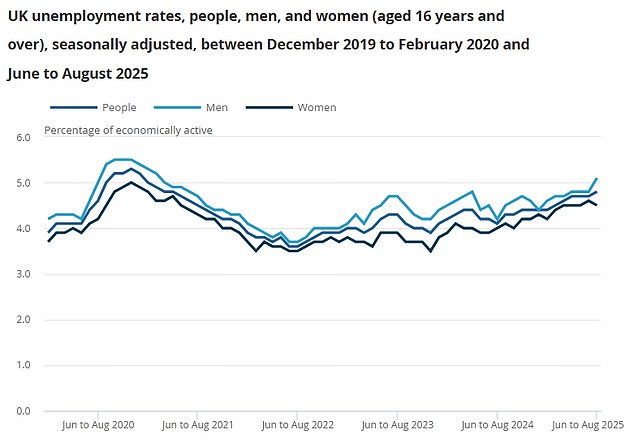
The UK’s labour market is facing significant challenges, with recent data showing an increase in unemployment to a four-year high. The jobless rate rose unexpectedly from 4.7% to 4.8% in the three months leading up to August, marking the highest level since the early days of the Covid-19 pandemic in 2021. This trend highlights the ongoing struggles within the economy as businesses and workers navigate a complex landscape.
In addition to rising unemployment, there has been a noticeable decline in job vacancies and payroll numbers. The number of people claiming benefits also increased in the month leading up to September. A concerning sign is that 1.7 million individuals over the age of 65 are still working, indicating the financial pressures many Britons are experiencing.

Economic Indicators and Trends
The Office for National Statistics (ONS) reported some signs that the labour market may be stabilizing, but experts caution that it remains more fragile than at any time in recent years. Regular wage growth slowed to 4.7% in the three months to August, down slightly from 4.8% in the previous quarter. When accounting for CPI inflation, pay increases were recorded at 0.9%, the lowest level in two years.
Private sector wage growth also slowed to its lowest rate in nearly four years, reaching 4.4%. In contrast, public sector pay growth increased to 6%, which the ONS attributed to some public sector pay rises being awarded earlier than in the previous year.
Payroll and Vacancy Data
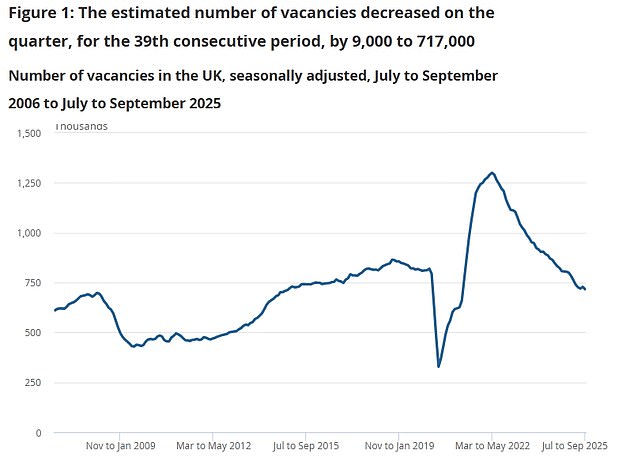
Payroll numbers saw a slight increase of 10,000 between July and August, but early estimates suggest a drop of 10,000 in September, bringing the total to 30.3 million – 100,000 lower than the same month in 2024. Vacancies fell by 9,000 to 717,000 in the quarter to September, marking the 39th consecutive period of decline.
The Claimant Count, which measures the number of people claiming unemployment benefits, rose to 1.692 million in the month to September, although it decreased compared to the previous year. Liz McKeown, director of economic statistics at the ONS, noted that after a long period of weak hiring activity, there are signs that the declines in payroll numbers and vacancies are now leveling off. She highlighted different patterns across age groups, with record numbers of over-65s in work, while the rise in unemployment was mainly driven by younger people.
Positive Developments
Despite the overall bleak outlook, there were some positive developments. Total wage growth, including bonuses, was revised upward for the quarter to July from 4.7% to 4.8%. This metric is used in the state pension triple lock calculation, suggesting that the increase in April could be higher than expected at 4.8%.
Additionally, the data revealed a record number of 1.7 million over-65s in employment in the quarter to August. This represents a 6.7% increase from the previous quarter and an 11.8% year-on-year rise.
Expert Opinions
Martin Beck, chief economist at WPI Strategy, suggested that the latest UK labour market numbers indicate a potential stabilization after a period of softening. He pointed to the impact of the April rise in employer national insurance contributions and the sharp hike in the national living wage on hiring activities. However, he noted that the worst of the damage may be passing.
Matt Swannell, chief economic adviser to the EY Item Club, emphasized that even though wage growth has fallen, the Bank of England will need further evidence that inflation pressures are easing before cutting interest rates again. He predicted that the Bank of England would not cut the Bank Rate until the first half of 2026.
Conclusion
The UK’s labour market continues to face significant challenges, with rising unemployment, declining vacancies, and financial pressures on workers. While there are some signs of stabilization, the overall picture remains fragile. As the economy navigates these difficulties, the focus will remain on how policymakers and businesses respond to these ongoing issues.