

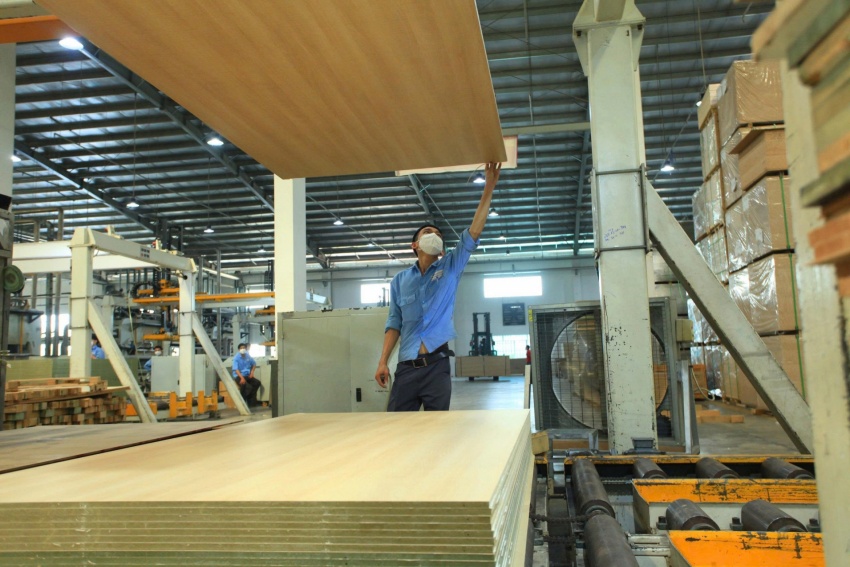
Vietnam’s Timber Industry Aims for $16.9 Billion in Exports by 2025
Vietnam’s timber industry is setting its sights on a significant milestone: achieving an export value of $16.9 billion by 2025. This ambitious target highlights the sector’s growing importance to the national economy and its potential to contribute to sustainable development.
The Vietnam Timber and Forest Products Association (VIFOREST) has been actively advocating for policy changes that could help the industry reach this goal. One of the key proposals is the elimination of Value Added Tax (VAT) on primary wood products, which would classify them as agricultural outputs exempt from VAT. VIFOREST also calls for the consistent application of Decree 209/2013/ND-CP, which states that normally processed plantation timber should not be subject to VAT.
According to the association, these reforms would alleviate administrative burdens on processing and exporting firms, reducing compliance costs and freeing up working capital. “Our goal is to ease administrative bottlenecks, mitigate legal risks, and prevent losses to the state budget from invoice fraud,” VIFOREST stated in its report. The move is also expected to protect the incomes of millions of rural households engaged in afforestation.
Sector Achievements and Challenges
Vietnam currently maintains over 4.6 million hectares of planted forests, producing an annual harvest of 35–40 million cubic meters of timber. This supply meets approximately 75–80% of the processing demand. The export turnover of wood and wooden products is forecast to reach $16.9 billion in 2025, making it one of the country’s top export categories.
The industry provides direct employment for more than 500,000 workers and supports millions of smallholder tree growers. However, despite these achievements, the sector faces acute liquidity challenges. Preliminary figures from VIFOREST indicate that timber enterprises are waiting for VAT refunds worth around VND6.1 trillion ($250 million). These delays are linked to current procedures that require refunds to be processed only after thorough review.
Impact of Refund Delays
On paper, the system is designed to secure the state budget. In practice, it has stalled refund approvals for compliant businesses. “Many companies have complete and legitimate dossiers, yet they are still asked to provide additional clarifications over and over again,” noted Cao Xuan Thanh, chief of office at VIFOREST. He stressed that refund processing often exceeds statutory deadlines, causing serious cash flow disruptions.
Thanh pointed out that the requirement to trace raw material origins back to individual households is especially unrealistic. “A single export shipment may be sourced from dozens of growers across multiple provinces,” he explained. “The verification process becomes unworkable, and that is where enterprises get stuck.”
The consequences are immediate. Exporters are forced to advance 10% VAT on input materials while awaiting refunds, eroding their capacity to rotate capital. This hits small- and medium-sized firms the hardest. With industry-wide profit margins averaging only 5–7%, the sector loses an estimated VND500–600 billion ($20–25 million) annually due to refund delays, equivalent to 2–3% of total profit.
International Implications
Delayed refunds also damage Vietnam’s standing abroad. Foreign clients experience late deliveries and deferred payments, eroding confidence. More dangerously, exporters risk sanctions under the EU’s regulation on deforestation-free products (EUDR). “If traceability obligations are not properly met, the EU could issue yellow or red cards, which would severely hurt our market access,” VIFOREST warned.
Nguyen Liem, vice chairman of VIFOREST, added that product classification is another barrier. He observed that plantation timber after harvest, such as logs, sawn timber, peeled veneer, or woodchips, has not been clearly recognized as “primary processed” goods. “Because of this ambiguity, exporters accumulate large VAT credits that cannot be refunded in time,” he said.
Liem further noted that both enterprises and small traders are still obliged to declare and pay VAT even on minimally processed timber, increasing costs and paperwork. In his words, “These procedures consume enormous time and resources, but the refunds remain out of reach. This has paralysed business cash flows and put many companies at risk.”
Broader Risks and Shifts
The risks extend beyond liquidity. Several exporters waiting on refund larges have been accused of enjoying state subsidies in trade defense investigations overseas. Domestically, extended refund disputes can push legitimate businesses into legal jeopardy. Meanwhile, the “request-and-grant” nature of the current system leaves room for arbitrary delays and even corruption.
These obstacles are driving a troubling shift: some companies now prefer to import timber rather than purchase from domestic plantations, simply to avoid VAT refund complications. This undermines demand for local wood, stripping millions of farmers of stable buyers and disincentivising reforestation.
Conclusion
VIFOREST’s message is clear: resolving VAT refund issues is not merely about tax administration. It is about preserving national reputation, protecting farmers’ livelihoods, and securing the industry’s competitiveness in a global market increasingly focused on sustainability.
In its petition, the association stresses that timely VAT reform will immediately free up liquidity, reduce exposure to legal risks, and enhance compliance with international traceability standards. More broadly, it would help solidify Vietnam’s position as a reliable, responsible supplier of timber products.
“Unlocking these refunds is not a privilege, it is a necessity,” Liem underlined. “Without it, the industry cannot play its intended role as a pillar of the green, circular economy.”