
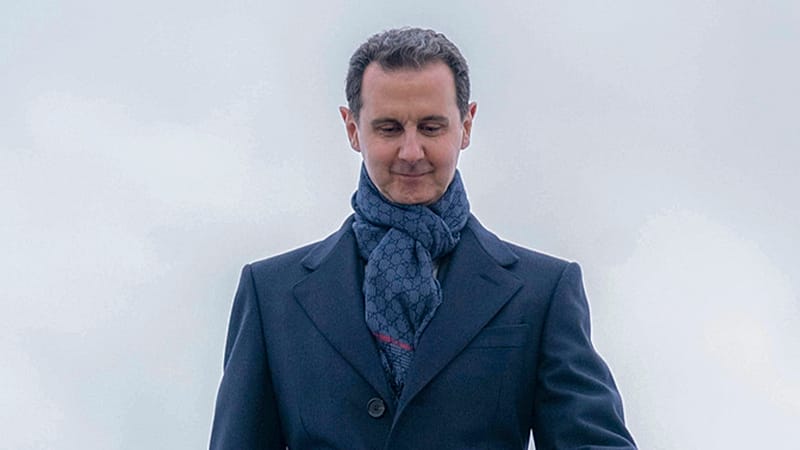
Nearly a year after his departure from Syria, former President Bashar al-Assad is reportedly living under tight restrictions imposed by Russia in Moscow. His movements are limited, and public appearances are forbidden, according to various reports.
Al-Assad fled Damascus on December 8, 2024, when forces loyal to interim President Ahmed al-Sharaa seized control of the capital. He issued a single public statement eight days later, on December 16, claiming his exit “was not pre-planned” and that he intended to continue fighting. However, Moscow insisted on his “immediate withdrawal.”
Since then, Al-Assad has maintained near silence. His eldest son, Hafez, named after Bashar’s father, who he succeeded, released a video in mid-February. The video showed him walking near the Kremlin and recounting the family’s hasty departure from Syria. However, Al-Assad himself has made no further public comments.
In October, Russian Foreign Minister Sergey Lavrov confirmed that Al-Assad and his family reside in Moscow, stating that Russia granted them asylum for humanitarian reasons.
According to Russian Ambassador to Iraq Elbrus Kutrashev, Russia imposed strict conditions on Al-Assad’s stay when granting asylum in April 2025. Kutrashev told the Islamic Republic News Agency that Al-Assad must refrain from all media appearances and political activities.
Allegations of Poisoning and Health Concerns
In September, the Syrian Observatory for Human Rights reported that Al-Assad was hospitalized in critical condition after a suspected poisoning. The monitoring group claimed he spent nine days in a hospital on the outskirts of Moscow before being discharged on September 29.
Lavrov denied the poisoning reports in October, stating that Al-Assad “has no issues living in our capital.”
The Syrian Observatory for Human Rights, based in the UK, stated that Russian secret services keep Al-Assad under exceptionally strict protection. His movements are highly restricted, and he has ceased making public speeches.
Al-Assad’s wife, Asma, was diagnosed with acute myeloid leukemia in May 2024, according to an announcement from the Syrian presidency. She had previously battled breast cancer and was declared cancer-free in 2019.
- The Telegraph reported in late December 2024 that doctors gave her a 50/50 chance of survival. Sources indicated that she was in isolation in a Moscow hospital to avoid infection.
Details of Al-Assad’s Life in Moscow
Die Zeit reported in October that Al-Assad resides in Moscow’s modern financial district, although the exact location remains unconfirmed.
A source close to the Al-Assad family told Die Zeit that the family owns multiple apartment units and sometimes stays in a villa outside Moscow.
- The apartments are described as luxury units with high ceilings, floor-to-ceiling windows, and access to shopping centers and restaurants.
The source claimed Al-Assad “spends much of his time playing online video games” and is guarded by bodyguards from a private security company paid for by the Russian government.
Financial Holdings and Extradition Requests
Reports indicate that between 2018 and 2019, the Al-Assad regime transferred approximately $250 million (€237 million) in cash to Moscow, with at least 18 luxury apartments purchased by clan members in the city.
The US State Department estimated Al-Assad’s family wealth at between $1 billion (€950 million) and $2 billion (€1.9 billion) in 2022, allegedly funded from “arms and drug trafficking and the rental economy” through shell companies.
Syria’s transitional government under Al-Sharaa has requested Al-Assad’s extradition for trial. Russia has refused to hand him over, with the Kremlin maintaining that President Vladimir Putin personally granted him asylum, a decision that will not be reversed.